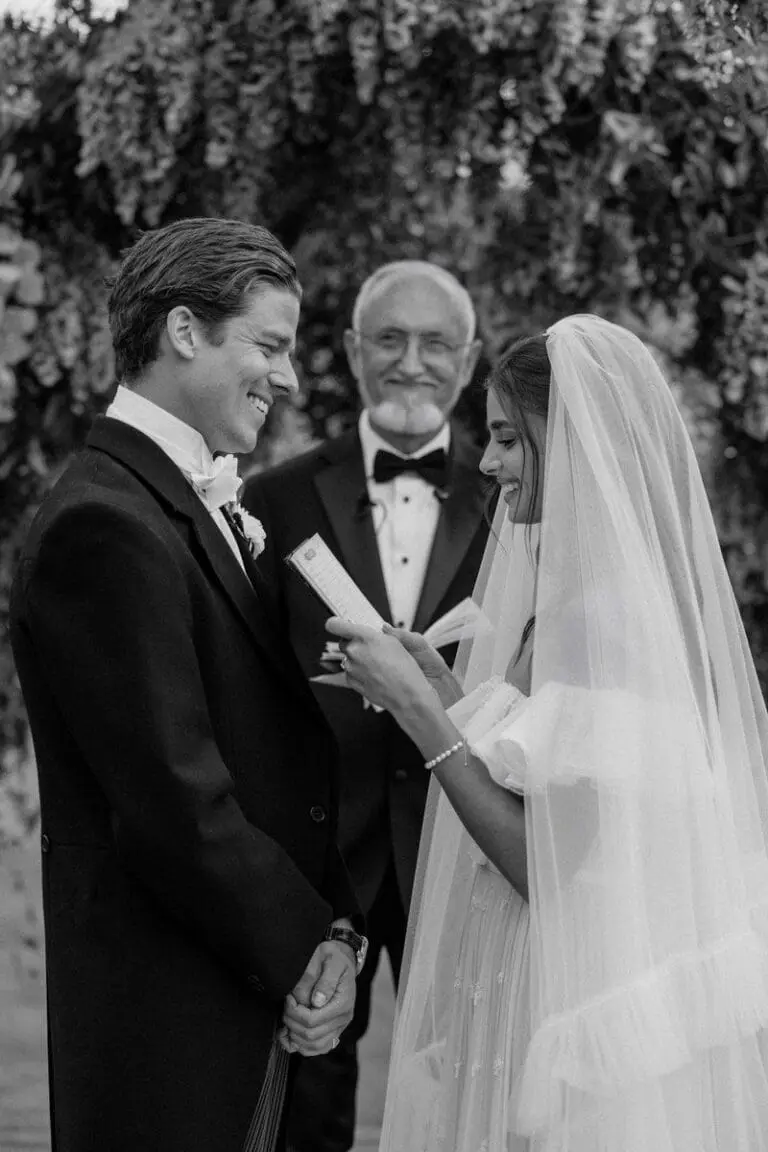
Writing your vows, for a wedding, an anniversary, a birth or the new year, can seem simple at first glance. After all, you "just" have to talk about your feelings. But that is exactly the point: putting emotions into words is anything but automatic. Many people find themselves paralysed by blank-page syndrome, that strange feeling that everything matters… and is therefore impossible to put into words.
The pressure doesn't help. You want to avoid platitudes. You want to move people without overdoing it. You want to be sincere without being clumsy. So you wait for "the right sentence". It doesn't come.
The good news? Emotion can't be forced, but it can be worked on. Like a muscle, writing becomes more fluid when it is given concrete footholds. It isn't about being a writer, but about being true. With the right methods, simple exercises and a few clear markers, you can turn that intimidating silence into a personal, lively and moving text, without falling into clichés or chasing perfection.
Why the blank page holds us back
It isn't a lack of love or a lack of inspiration that explains the silence in front of the blank sheet. On the contrary, if writing becomes difficult, it is often because the stakes are high. You want to do it well, you want to get it just right.
The fear of being too ordinary quickly sets in. You dread writing sentences you have heard before, phrases seen a thousand times, words that might seem bland or impersonal. So you delete before you have even begun.
Add to this the pressure to "live up to it". To live up to the relationship, the occasion, the other person's supposed expectations. The stronger the emotion, the more you fear expressing it badly. This invisible standard can become paralysing.
Finally, there is the desire to be perfect. To find the ideal sentence, the exact word, the flawless structure. But this quest for perfection freezes the writing. By wanting everything to be exceptional, you block the natural flow of ideas.
The result: you write nothing. Yet successful vows aren't perfect, they are authentic. What moves people isn't performance, but sincerity.
Method 1: Sensory memory
Instead of immediately looking for "what to say", change your starting point. Don't look for a beautiful sentence. Look for an image. Simply ask yourself: what is the first scene that comes back to me spontaneously? Which precise moment, almost ordinary, yet deeply memorable?
Think in sensory terms. What smell comes back to you? A coffee shared too early in the morning, a familiar perfume, the salty air after a walk by the ocean? What specific place appears? A street, a kitchen, a quay, a car pulled over on the roadside? What almost invisible detail resurfaces: a burst of laughter, a hand on a shoulder, a sentence whispered softly?
Exercise: take five minutes to write down three very concrete memories. Not generalities. Not "our holidays", not "our happy moments". Look for the exact scene.
Avoid vague phrases such as:
"We've shared incredible moments."
Prefer something embodied:
"I remember that rainy Sunday on the Bordeaux quays, when we ran through the rain laughing, soaked but happy."
In the second sentence, you can see the scene, feel the rain, hear the laughter. Detail turns an abstract memory into a living experience. And that is precisely where emotion is born.
Method 2: The unfinished sentence
Sometimes what holds you back isn't the emotion, but the starting point. To get around this, use the unfinished sentence technique. It lets you start writing without pressure, almost like a conversation begun in a low voice.
Spontaneously complete simple sentence openings:
"Before you, I…"
"With you, I learnt…"
"I've never told you that…"
"If I had to sum up our story in one image…"
The aim isn't to write something beautiful. The aim is to write something true. Don't think too long. Dive in and let the words come, even if they seem imperfect, clumsy or too simple.
Give yourself five minutes of continuous writing. Don't correct anything. Don't reread straight away. This spontaneous writing often brings out unexpected phrasing that is more natural and more personal.
Raw sincerity is often more moving than an overworked text. It is in this first, still imperfect material that you will find the truest sentences.
Method 3: A simple three-part structure
When emotion runs high, it is easy to scatter. Memories flood in, ideas get tangled and the text loses clarity. To avoid getting lost, adopt a simple, effective three-part structure. It acts as a common thread and helps you organise your thoughts without rigidity.
Start with the past. Tell how it all began. A meeting, a detail, a first impression, a founding moment. It isn't about retracing everything, but about setting the starting point, the one that gives meaning to what you are living today.
Move on to the present. Explain what the person means in your life now. What they have changed, what they bring, what you feel by their side. This part is often the most intimate, because it speaks of your current balance, of the place they hold in your everyday life.
Finally, open onto the future. Express what you want to build, share and go through together. No need for grand promises. Sometimes, mentioning simple things, carrying on laughing at the same jokes, facing the unexpected as a pair, supporting each other in projects to come, is enough to make this vision sincere and moving.
This natural progression reassures the writer as much as the listener. It gives rhythm, builds the emotion and lets you finish on a forward-looking note, full of momentum and coherence.
How to avoid clichés
Some words are beautiful, but through overuse they lose their strength. Expressions such as "soulmate", "forever" or "the love of my life" sound intense, but they remain generic. They could apply to almost any story.
The problem isn't that they are false. It is that they say nothing specific about your relationship. And what moves people deeply is the singular, not the spectacular.
Rather than stating a grand idea, show it through a precise situation.
Instead of writing:
"You are the love of my life."
Try:
"You are the only person I can talk to for two hours without noticing the time go by."
In the second sentence, you grasp the intensity of the bond without it being declared head-on. You sense the closeness, the ease, the presence.
Emotion comes from the concrete. The more you describe gestures, habits and scenes you have lived, the more embodied your words become. And it is these details, sometimes simple ones, that make your vows deeply personal.
Express exercise: 10 minutes on the clock
If you are short of time or feel inspiration is slow to come, this quick exercise unlocks the essentials in a few minutes. It rests on a simple idea: start from observation rather than declaration.
Begin by writing a list of ten specific things you love about the person. Avoid overly broad qualities such as "kind" or "amazing". Look for concrete things: the way they tell a story, their quiet laugh, the way they reassure you, their look when they are concentrating, their unexpected sense of humour.
Once the list is done, reread it and circle three. Not necessarily the most impressive, but the ones that touch you most.
For each of these three qualities, then tell a short, real scene that illustrates it. A moment you lived, however brief. It is this shift from the abstract word to the concrete situation that gives depth to your vows.
For example:
"I love your patience. Like that day when I doubted everything, and you simply placed your hand on mine without trying to fix it all."
Here the quality isn't just stated, it is embodied. You see the gesture, you feel the support.
Simple. True. Enough.
Links to a few tips
In short…
The most beautiful vows aren't the most literary. They don't try to impress. They are personal, rooted in a real story, in gestures, in shared memories. A hesitation in the voice, a slightly trembling breath, an unexpected smile, a slightly clumsy but sincere sentence are often worth far more than perfectly crafted phrasing.
We sometimes think we have to write "like in a film" for it to work. In reality, what moves people is the truth of the moment. Words that are too polished, too worked, can create distance. Conversely, a simple sentence spoken from the heart creates an immediate connection.
Whether you are writing from a café in the centre of Bordeaux, facing the windswept dunes of the Atlantic coast, or from your living room in Nouvelle-Aquitaine, remember that the blank page isn't an obstacle. It is a space. A space to tell your story your own way.
And sometimes all it takes is one imperfect first sentence, written without overthinking, for everything to open up. Because when it comes to vows, it isn't perfection that stays with people, but authenticity.
Lovely Day Event offers several services
Wedding planning
I step in at every stage of your preparations and guide you through your choices, bringing ideas and suggestions so that your wedding looks like no one but you.
Wedding design
Creative and passionate, I am a certified Wedding Designer and I create a scenographic atmosphere that matches the theme of your wedding.
On-the-day coordination
I will be the conductor of your day, managing the suppliers, the set-up of your decor and the smooth running of this beautiful day.